CAMF, a New Architecture for Crypto Funding Systems
Priorities Extracted from This Source
#1
Coordinate non-dilutive funding mechanisms into a unified system
#2
Create shared taxonomy, vocabulary, and metrics for capital allocation
#3
Align capital deployment with long-term ecosystem strategy and intent
#4
Improve builder progression, retention, and sustainability
#5
Strengthen accountability, assessment, and learning across funding cycles
#6
Clarify governance roles and responsibilities in funding decisions
#7
Make capital flows legible, comparable, and efficient
#8
Reduce waste and restore credibility in grants and related programs
Document Content
Full text from all 1 processed chunks:
Chunk 0
### Addressing the the Coordination Failure at the Core of Crypto Non-Dilutive Programs
Funding in Web3 is not a linear pipeline; it is a circular system of interdependent roles funders, allocators, and builders where intent, decisions, and outcomes should reinforce each other over time. When this loop is connected, information compounds and strategy becomes learnable.
In practice, trust in non-dilutive mechanisms such as grants, accelerators, and hackathons is eroding. They are increasingly perceived as producing short-lived prototypes, temporary funding relief, or signaling value without delivering durable outcomes.
The failure is not the mechanisms themselves, but the absence of a system that connects intent to execution and execution to learning. Programs are designed in isolation, repeated without feedback, and assessed without shared context.
**Systemic breakdowns include:**
- Capital is deployed without a defined progression path, trapping teams in short-term funding cycles instead of moving them toward users, product maturity, and sustainability.
- There is no shared taxonomy or metrics across programs, making outcomes incomparable and preventing learning across funding cycles.
- Grants, hackathons, and accelerators operate as disconnected events rather than coordinated mechanisms within a builder lifecycle.
- Builders repeatedly reapply because there is no structured post-funding pathway, graduation logic, or off-ramp into sustainable growth.
- Funding decisions reset each cycle, reinforcing grant hopping and low builder retention rather than compounding ecosystem capacity.
The result is a loss of credibility in non-dilutive funding as a growth tool. CAMF was developed to address this gap by treating grants, hackathons, and accelerators as mechanisms within a shared lifecycle, aligning roles, intent, and assessment so capital decisions can be compared, improved, and, when necessary, retired. Grants are not broken; the architecture around them is.
---
## Capital Architecture Mapping Framework (CAMF)
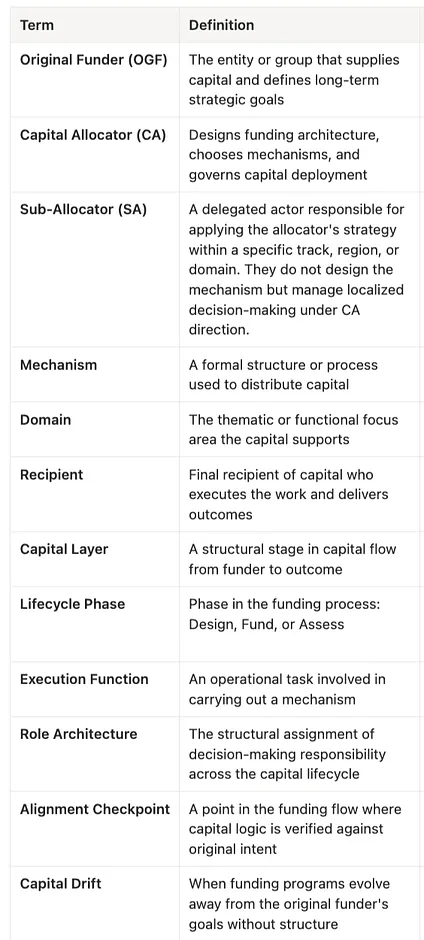
CAMF (Capital Architecture Mapping Framework) is a system design model and taxonomy for all non‑dilutive funding, not just grants. It gives protocols and foundations a common way to describe how capital moves through their ecosystem and how decisions are made at each layer.
**In practice, CAMF does three things:**
- Provides a shared vocabulary for roles, lifecycle phases, mechanisms, domains, capital layers, and execution functions.
- Turns disconnected programs into one continuous funding system: Design → Fund → Assess.
- Makes capital flows legible and comparable so strategy, accountability, and learning can compound across cycles.
**CAMF works in three high‑leverage modes:**
- **Mapping Mode:** Make the existing capital architecture visible. Map how intent, roles, mechanisms, and lifecycle phases currently interact (or fail to).
- **Orientation Mode:** Provide structural logic and decision anchors to interpret that map and redesign how funding should function going forward.
- **Strategy Mode:** Define how capital should be structured across roles, mechanisms, and lifecycle phases to achieve ecosystem goals, before programs are designed or funds are deployed.
At its core, CAMF treats non‑dilutive programs (grants, hackathons, accelerators, incubator ) as mechanisms that only create meaningful impact when they operate as part of the same coordinated system. Run independently, they generate activity without compounding effects; connected through a shared architecture, they reinforce each other, give builders a clear path through the ecosystem, and produce outcomes that extend beyond individual cycles. CAMF supplies the structure that links these mechanisms so they function as a coherent growth system rather than a series of fragmented subsidies.
**CAMF Explained (PDF explainer)**
### CAMF Utility
CAMF provides the structural model ecosystems need to turn fragmented funding activity into a coordinated, efficient, strategically aligned capital system.
- **Map and structure capital architecture:** Gives a unified view of who controls capital, how decisions are made, and how funding flows across mechanisms, creating the foundation for decision clarity and capital efficiency.
- **Define roles and flows:** Establishes a shared taxonomy for funders, allocators, mechanisms, and recipients, reducing ambiguity, preventing drift, and enabling coherent decision‑making across the ecosystem.
- **Drive strategic alignment:** Links capital deployment to long‑term intent so programs reinforce each other, outcomes are comparable, and progression can be measured across funding mechanisms.
- Enable operational systems: Provides the model behind dashboards, evaluators, rubrics, reporting templates, and workshops, giving ecosystems the infrastructure to track performance and enforce accountability at scale.
**Why it’s worth adopting:** CAMF reduces waste, increases builder retention, aligns programs, and creates a funding system where mechanisms compound instead of resetting each round, turning capital deployment into cohesive ecosystem strategy and real ROI.
## CAMF Components: The System Architecture of Funding
At its core, CAMF defines the structural elements that make funding coherent across time and actors. These components are practical mechanisms that allow programs to be mapped, compared, aligned, and improved. Each one captures a different slice of how capital moves through an ecosystem, and together they form the architecture that holds the system together.
### Roles
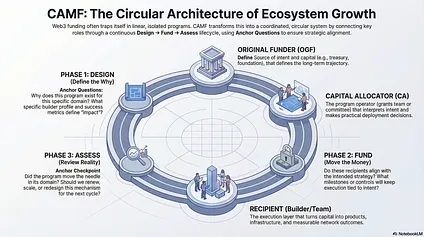
Roles define who is responsible at each point in the capital lifecycle and how intent and information move between them. They clarify how intent flows downward (funder → allocator → builder) and how information, outcomes, and accountability flow upward.
Instead of treating relationships as isolated pairs (funder ↔ operator or operator ↔ grantee), Roles create a full‑cycle structure where every actor is connected. This keeps decisions aligned with ecosystem goals rather than drifting into fragmented activity.
- **Original Funder (OGF):**The source of intent and capital. This is the treasury, foundation, or council that defines why funding exists, what gaps matter, and what long-term trajectory capital should drive.
- **Capital Allocator (CA):**The mechanism operator a grants team, committee, or accelerator lead. The allocator interprets intent, sets structure, and makes the practical allocation decisions that shape who enters the ecosystem and why.
- **Recipient (Builder / Team):**The team executing the work and turning capital into products, infrastructure, and usage. Recipients close the loop between strategy and real outcomes in the network.
**Why it matters;** When roles are not connected, ecosystems fund isolated activity instead of coordinated progression. Defining the Original Funder, Capital Allocator, and Recipient as interdependent actors in one system makes responsibility visible, aligns decisions to intent, and links outcomes back to the people who shaped them. This restores coherence across the lifecycle and makes ecosystem impact traceable rather than accidental.
**Component Stack:** Roles sits alongside Lifecycle and Domains. It defines _who_ owns intent, allocation, and delivery so that every decision in the funding cycle is tied to the correct actor and responsibility is traceable across the system.
### Lifecycle
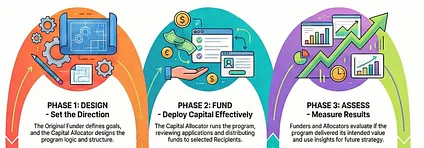
Lifecycle defines the full decision cycle a program goes through—how funding is conceived, deployed, and evaluated. It breaks every funding program into three linked phases: **Design → Fund → Assess**. In CAMF, these phases are not administrative steps; they are the structural checkpoints that make sure capital is tied to intent, deployed with alignment, and assessed against real outcomes. Lifecycle turns funding from one-off rounds into a coordinated, repeatable system that supports builder progression instead of random activity.
- **Design:** Define why the program exists, who it is for, what success looks like, and which mechanism and domain it will use. This is where goals, eligibility, criteria, and target builder profile are set so the program has a clear job to do.
- **Fund:** Run the program and move money according to the design: open applications or claims, review and select recipients using the chosen criteria and mechanism, and set any controls (milestones, vesting, reporting) that keep execution aligned with intent.
- **Assess:** Review what actually happened: did funded teams deliver, did the program move the target domain in the way you defined in Design, and what needs to change (renew, graduate, scale, or redesign) before the next cycle
**Why it matters:** Most funding programs today lack a clear lifecycle. Design, deployment, and evaluation happen in silos. CAMF introduces flow logic that ties every phase back to strategy so capital can be aligned, trackable, and iterative.
**Component Stack:** Lifecycle sits alongside Roles and Domains. It structures decisions over time—Design → Fund → Assess so every mechanism can be compared, improved, and aligned to ecosystem intent across cycles.
### Domains
Domains define the strategic vertical a program targets (for example: infrastructure, consumer apps, public goods, governance, or any ecosystem priority). They separate intent by vertical so program performance and builder impact are measured in the context they were designed for, rather than in a mixed, undifferentiated cohort.
**Why it matters:** Domains keep programs scoped, make impact comparable across categories, and reveal where an ecosystem is overfunding, underfunding, or misallocating capital. By anchoring each mechanism to a clear vertical, ecosystems can track whether funding is shifting the areas that matter, not just producing activity.
**Component Stack:** Domains sit alongside Lifecycle and Roles as the where in the system. They define the strategic vertical each program serves, so mechanisms, decisions, and outcomes are evaluated in the right context instead of in a mixed, undifferentiated pool.
---
### Mechanisms
Mechanisms are the funding programs ecosystems use to deploy capital—grants, hackathons, accelerators, bounties, and similar models.
**Why it matters:** In CAMF, a mechanism is treated as a capital tool, not a one‑off event. Most ecosystems run these programs as isolated cycles, making it hard to know whether they drive growth, support the right builder stage, or justify continued investment. By defining mechanisms as structured program types, CAMF makes them comparable, assessable, and measurable within a larger capital system.
**Component Stack:**Mechanisms sit on top of Lifecycle, Roles, and Domains as the how capital is deployed. They define the program type (grant, retro funding, rebate, accelerator, etc.) used within a given domain and lifecycle, so different tools can be compared, tuned, or retired as parts of one capital system
---
### Anchors
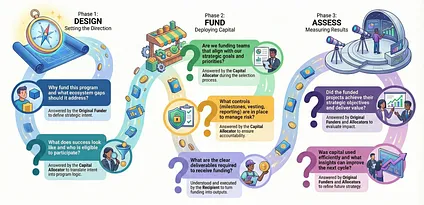
In CAMF, an **anchor** is a key connection point between roles or layers in the capital flow. It defines _who links to whom_, _at what stage_, and _why the relationship matters_ helping ensure strategy, deployment, and execution stay aligned.
Anchors are the guiding questions each role answers at every phase of the lifecycle. They link intent, criteria, outputs, and impact by forcing clarity on what is being decided, why it matters, and how success will be measured. Anchors surface assumptions, establish shared expectations, and align decisions across the Original Funder, Capital Allocator, and Recipient, making sure the system asks the right questions before capital moves, while it moves, and after outcomes appear.
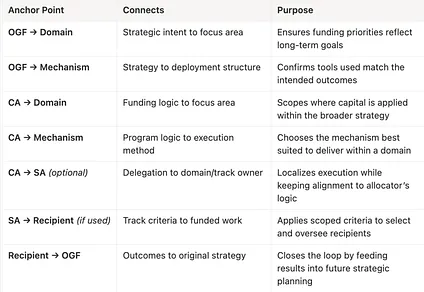
**Why it matters:** Without Anchors, programs drift intent becomes vague, allocation becomes subjective, and assessment becomes reactive. Anchors keep funders, operators, and builders aligned across the entire lifecycle, making decisions explainable and outcomes comparable, turning funding from guesswork into an accountable, reproducible process.
**Component Stack:** Anchors sit on top of Lifecycle, Roles, and Domains, guiding decisions without replacing them.
## CAMF Taxonomy
CAMF introduces a functional taxonomy to clarify how capital is structured and who controls each part of the funding lifecycle. These terms are used across all CAMF tools and assessments. They allow protocols to map their capital architecture consistently, compare funding structures, and identify gaps or overlaps.
This taxonomy separates **roles**, **layers**, and **structural components** so that programs and decisions can be understood systemically not just individually.